
Thinking of investing in a wind turbine? Here are the rules in Flanders
Are you considering installing a wind turbine on your business premises in Flanders? What costs and returns can you expect? Are there any other factors you need to take into account?
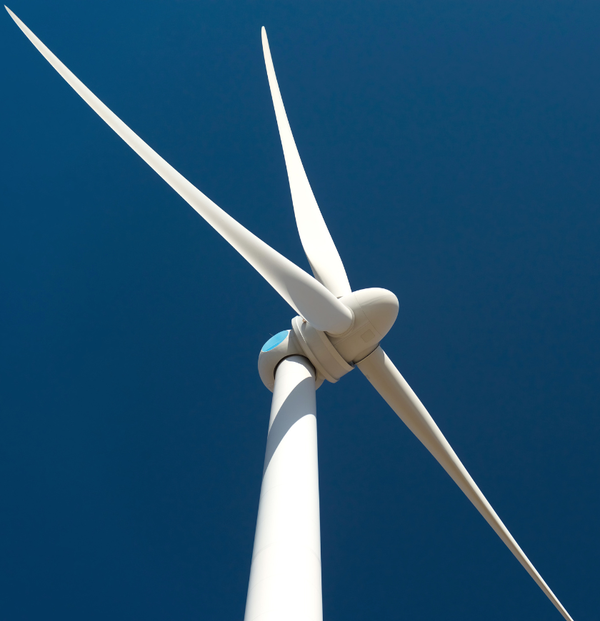
You should always choose the largest one
Wind turbines are typically available in two sizes:
- A medium-sized wind turbine is up to 120 metres tall (and usually quite a bit smaller). It has a capacity of less than 1.5 megawatts.
- A large wind turbine can have a total height of up to almost 300 metres. The rotor diameter for the largest types can reach 175 metres. The capacity ranges between 1.5 and 7.5 megawatts.
Please note! You can never opt for a medium-sized wind turbine if a large one is also an option. The legislation does not permit this: there is an obligation to always extract the greatest possible amount of energy from the environment. In this context, the term ‘energy optimisation’ is used (circular OMV/2024/01, point 3.1.2.1).
In practice? In Flanders, you must therefore always choose the largest possible wind turbine. Each project is always optimised based on the amount of energy that can be extracted from the wind in a given area, and not on the basis of local consumption at your business site. Any surplus electricity is fed into the grid.
How much will this cost you?
The investment costs for a large wind turbine can be divided into two phases:
- For the development phase (up to and including obtaining a permit), you should expect to pay between €150,000 and €200,000.
- For the construction phase (up to the actual commissioning of the turbine), you should budget for an amount between €5 million and €10 million. This amount depends heavily on the type of wind turbine and the total capacity.
Rule of thumb. The investment costs are generally €1,900 to €2,200 per kilowatt for a turbine with a capacity of 1,500 to 2,500 megawatts. If the capacity is between 6,000 and 7,500 megawatts, the costs drop to €1,400 to €1,600 per kilowatt.
Tip. A larger wind turbine is not only cheaper per megawatt, but also generates more electricity and is therefore more profitable.
Alternative financing. For SMEs and larger companies that are unwilling or unable to provide the full capital, alternative investment options exist. For example, they can invest themselves up to the point of obtaining the permit, and then put the permit on the market to allow an external investor to realise the project. They can also make their business site available to an external investor: the investor then bears all the costs, and in return the company receives an annual payment from the date the wind turbine comes into operation.
What returns can you expect?
Typical returns (before financing and taxes) for large wind turbines are:
- 7% to 8% for projects without self-consumption (i.e. 100% grid feed-in, such as alongside a motorway);
- 14% to 15% for projects with self-consumption (such as on industrial estates).
Significant differences. Electricity yields are highly dependent on the type of wind turbine. They can vary between 5,000 and 15,000 megawatt-hours per year. The final payback period depends heavily on the size of the turbine, the financing, the level of self-consumption, electricity prices and the location. After all, the wind blows less strongly in the province of Limburg than in East and West Flanders.
- Example: A turbine with a lower capacity and an efficiency of 7% to 8% has a payback period of 12 to 15 years in Limburg when 100% of the generated electricity is fed into the grid. That efficiency increases significantly when the company uses this electricity itself for its own consumption. Depending on the energy contract and the volume of electricity purchased, the payback period can then be reduced to 8 to 12 years.
- Example. For a large wind turbine in East or West Flanders, where the electricity generated is largely consumed by the company itself, the return can reach 14% to 15%. This translates into a payback period of just 6 to 8 years.
No surprises for 25 years
You should also view an investment in a wind turbine as a fixed contract that you enter into for a period of 25 years. This means that from day one, you know exactly how much you will pay for electricity throughout that entire period. You therefore need not worry about price rises.
LCOE. Exactly how much you will pay is expressed via the so-called levelised cost of energy (LCOE). This is calculated by dividing the total costs of the project (investment costs, operational costs, maintenance costs, etc.) by the total amount of electricity produced over its lifetime. The LCOE of a large wind turbine currently ranges from €40 to €80 per megawatt hour, depending on its size and location.
Please note! However, FEBEG, the federation of Belgian electricity and gas companies (https://www.febeg.be/nl/nieuws/wind-heeft-nood-aan-investeringszekerheid), warned in 2024 of a 31% increase in the LCOE compared to the 2016–2020 period. This is due, among other things, to increased turbine prices (by 30% to 40%) and height restrictions in Flanders.
There are, however, a few obstacles
Permits. The biggest obstacle in the entire process is the permit application. Given the large number of advisory bodies that give their views on the case during the procedure, it is important to substantiate the application as thoroughly as possible and to involve the various stakeholders in the process as early as possible.
Public support. All manner of action committees are increasingly springing up in response to permit applications. These are often based on misinformation and are fundamentally opposed to wind energy. Many objectors do not even appear to live near the project in question. All this frequently results in an exhausting legal battle.
Distance regulations. Flemish Minister for the Environment Jo Brouns also wishes to introduce new distance regulations that will make the installation of large wind turbines much more difficult. In future, wind turbines over 200 metres high may have to be situated at least three times their tip height away from the nearest house. A turbine of, for example, 220 metres would therefore have to be located at least 660 metres from the nearest dwelling. Although no official ministerial circular has yet been published on this matter, this distance criterion is highly restrictive.
Other regulations. Currently, there are already other very strict regulations in Flanders (stricter than in other regions) regarding noise pollution and shadow flicker. An overview of these can be found at https://www.vlaanderen.be/bouwen-wonen-en-energie/groene-energie/windenergie.
In Flanders, you are legally obliged to always install the largest possible wind turbine. The payback period varies between 6 and 15 years, depending on the size, the financing, the level of self-consumption, electricity prices and the location. You can also count on a fixed electricity price for 25 years.

Robin Bruninx
Founder and Chairman of the Board of Encon