
Minister Demir makes history by presenting the Encon Energy Award at a virtual ceremony
Bilzen/Brussels/Leuven/Schoten – As is customary, the Flemish Minister for Energy once again presented the Encon Energy Award this year to the student with the best final-year project on sustainability and energy efficiency. This 9th edition was particularly special, however, as the ceremony took place entirely online. Minister Demir proved willing to embrace this innovative approach, demonstrating that even in challenging times, a little creativity can make a great deal possible.
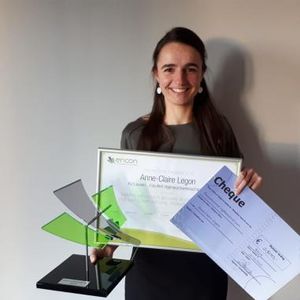
“During the COVID-19 pandemic, we have all had to find creative ways of doing things,” says Robin Bruninx, Managing Director of Encon and Chair of the Encon Energy Prize jury. “That is why we decided to organise this year’s award ceremony entirely online. We are particularly grateful to Minister Demir for embracing this virtual format and helping us make it a success.”
Flemish Minister for Energy Zuhal Demir welcomed the initiative: “This innovative format perfectly reflects the innovative character of the winning thesis, and I am pleased to support it, even in times of social distancing. The award recognises a talented Flemish engineer who is making a meaningful contribution to the energy transition. As renewable energy becomes increasingly important in Flanders, this research demonstrates that the transition can also be economically viable. It is therefore a project that deserves recognition and visibility.”
Thesis paves the way for a flexible residential energy market
This year’s highly coveted Encon Energy Prize was awarded to KU Leuven student Anne-Claire Legon. Through her research on flexible energy consumption in residential buildings, she has delivered valuable insights that can help accelerate the energy transition in the residential sector.
The ninth edition of the Encon Energy Prize once again attracted a strong field of high-quality submissions. After careful deliberation, the jury unanimously selected Anne-Claire’s thesis as the winner.
“The residential renewable energy market is still in its infancy in Flanders,” says Robin Bruninx. “This makes Anne-Claire’s work not only innovative but also highly relevant in practice. In addition, she succeeded in presenting a complex subject in a remarkably clear and accessible way, which is no small achievement.”
Private households will play an increasingly important role in the energy transition
The share of renewable energy in our energy system continues to grow. Unlike conventional energy sources, however, renewable generation depends on weather conditions that cannot be controlled. We cannot decide when the wind blows or when the sun shines. What we can influence is our energy consumption: when we use electricity, how much we use, and for how long.
Anne-Claire Legon’s research focuses precisely on this challenge.
“In today’s energy market, electricity generation is still largely adjusted to meet demand,” she explains. “As renewable energy becomes more dominant, we will increasingly need to move towards a system in which demand adapts to available supply. My thesis investigated whether such a transition is feasible and how it could be implemented.”
The homes of the future are expected to rely far more heavily on electric heating technologies such as heat pumps, leading to significantly higher electricity consumption. At the same time, a growing share of renewable energy will require greater flexibility within the electricity grid.
At the heart of Anne-Claire’s thesis is a sophisticated mathematical model that anticipates future conditions and optimises current energy consumption accordingly. Using a neighbourhood as a case study, the model intelligently manages household heating demand. The result is greater household comfort, lower energy costs and more efficient use of available renewable energy.
“This research demonstrates that flexible energy consumption, aligned with renewable energy availability, is not only possible but also beneficial,” says Bruninx. “It gives us confidence that a future in which renewable energy forms the backbone of our energy system is well within reach. Increased flexibility can also help reduce the cost of maintaining and expanding the electricity grid, reinforcing my conviction that sustainability ultimately delivers economic value as well.”
A future in which renewable energy is the norm — including for private households — appears one step closer thanks to this research.
Minister Demir also emphasised the pioneering role of Flanders in this field: “It is inspiring to see young Flemish students, and in this case a talented young woman, helping to find solutions to the many challenges associated with the energy transition. As a proud Limburger, I would also like to thank Encon, a company rooted in Limburg, for giving these students and their ideas the recognition they deserve.”

Robin Bruninx
CEO and founder